Booking your first cruise can feel like a lot — muster drills, tender ports, drinks packages, dress codes, all the little unwritten rules nobody explains upfront. The good news: it’s a lot simpler once someone actually walks you through it.
Our friends at The Velvet Notebook have put together exactly that — a genuinely brilliant, honest, first-timer’s guide to cruising: what to sort out before you sail, what to expect on embarkation day, and how to actually enjoy your time onboard and ashore. If this is your first cruise (or you’re helping someone plan theirs), it’s well worth ten minutes of your time.
Once you’ve picked your cruise line and dates, come back and let us do the price-hunting for you — we track live prices across the major lines so you can spot a genuine bargain before you book.
Is a Cruise Drinks Package Worth It? Here’s How to Actually Tell
Cruise lines make drinks packages look like a no-brainer. Sometimes they are — and sometimes they’re a quiet way to add £300+ to your fare for drinks you’d never actually get through. The only way to know which one you’re looking at is to do the maths.
The one number that decides it: your break-even
Every drinks package has a hidden “break-even” point — the number of drinks you’d need per day, at the price you’d normally pay, for the package to actually save you money. Below that number, you’re better off paying as you go. Above it, the package wins.
Rough example: a package priced at $75/night including gratuity, against drinks averaging $9 each, works out to roughly 8–9 drinks a day to break even. If that sounds like more than you’d realistically drink on a relaxed sea day, the package probably isn’t for you — at least not on this sailing.
Why the same package can be worth it on one cruise and not another
The break-even math shifts with three things: how many nights you’re sailing, how expensive drinks are on that particular ship, and whether gratuity is already baked into the headline price. A package that’s a clear win on a 12-night luxury sailing with premium spirits can be a loss on a 4-night cruise where you’re mostly by the pool with a beer in hand.
What most people forget to factor in
Gratuity. Most lines add 15–20% service charge on top of the package price — that alone can shift the break-even by a drink or two a day.
Included packages. Some lines (Norwegian’s Free at Sea, Oceania’s House Select, MSC promos) already bundle a package into the fare for free or a small upgrade — check before you pay extra for one.
Per-drink price caps. Packages usually cap out at a certain price per drink (e.g. $14–$20) — order something above that and you’ll still pay the difference.
Days you won’t drink much. Port days, seasickness, early excursions — be honest about how many days you’ll actually hit your break-even number.
The fastest way to check
Rather than doing this maths by hand for every cruise line’s package (they all price and structure differently), we built a free calculator that does it instantly — covering all the major lines, their real July 2026 package pricing, and gratuity rules baked in. Enter your nights, drinks per day, and average drink price, and it tells you straight away whether the package pays off.
Pricing referenced above is illustrative and based on our July 2026 research — always check current pricing directly with your cruise line before booking, as packages and promotions change frequently.
A cruise fare can look like brilliant value — until the extras pile up. The good news: once you know what’s included and what isn’t, that headline price becomes much easier to judge. Here’s exactly what your fare buys, and where the add-ons hide.
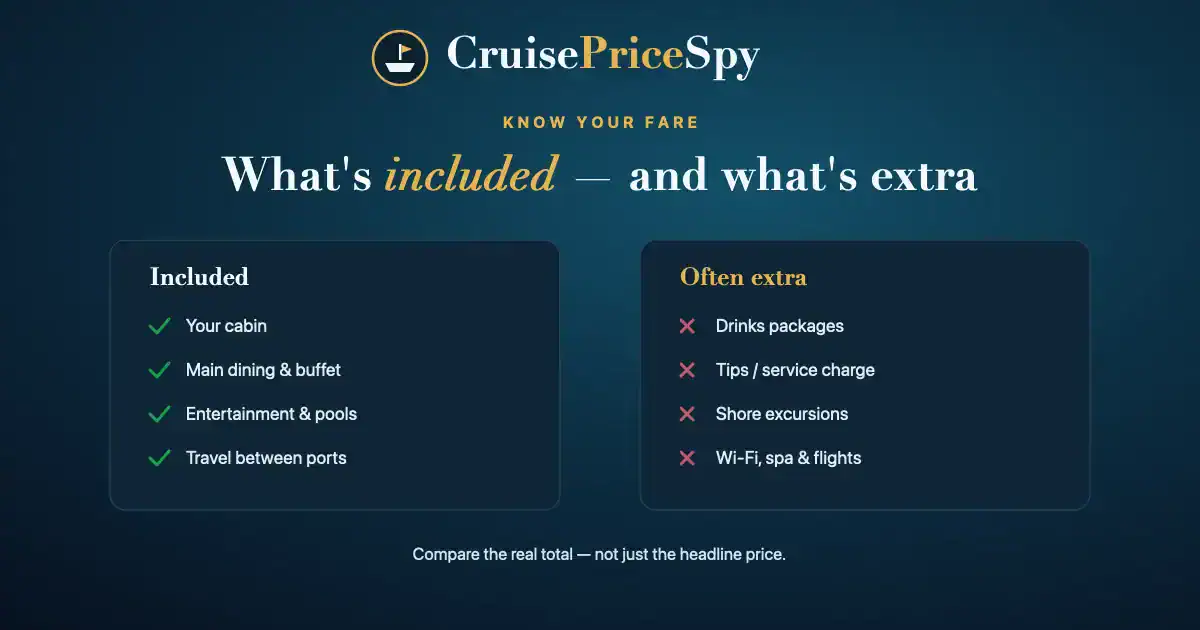
What’s (almost) always included
For one price, a cruise bundles together things you’d pay for separately on a land holiday:
Your cabin for the whole trip
Travel between destinations — you unpack once and the hotel sails with you
Main dining — multi-course meals in the main restaurants and the buffet
Entertainment — shows, live music, bars, pools, the gym and most onboard activities
Getting to multiple countries in a single trip, often without a single flight
Put that together and the value is obvious — which is exactly why comparing by Price Per Person Per Night (PPPN) makes sense.
This is where budgets quietly stretch. The most common add-ons:
Gratuities / service charge — often £10–£18 per person, per day, sometimes added automatically. Are they compulsory? We’ll cover that in a later blog
Drinks — alcohol, speciality coffees and soft drinks are usually extra unless you buy a package
Speciality dining — the headline restaurants beyond the main ones almost always carry a cover charge
Shore excursions — the cruise line’s organised trips in port can be pricey but you have the added security the ship won’t leave without you.
Wi-Fi, spa, photos and the casino — all charged on top
Flights and transfers — unless you’re sailing from a UK port (one reason UK departures can work out cheaper)
All-inclusive isn’t always cheaper
Some lines (and some fares) bundle tips, drinks and Wi-Fi into the price. That can be great value — if you’d use them all. If you’re not a big drinker, a “drinks included” fare may just be a higher price you don’t need. Always compare the total you’ll actually spend, not the label on the brochure.
How to compare fares honestly
A fare with everything bundled in will look dearer than a “cabin-only” fare that nickel-and-dimes you onboard. To compare like with like:
Start from the PPPN to rank sailings by base value.
Add the extras you’ll actually use (tips, a drinks package if you want one, any flights).
Compare those real totals — not the headline prices.
Let the tracker do the heavy lifting
Our free tracker ranks live fares across Cunard, Royal Caribbean, Virgin Voyages and P&O by PPPN, so you start from a fair baseline and add extras from there — with price-drop and lowest-yet flags to catch the genuine bargains.
Pop us an email to tell us which one you’d like to see.”
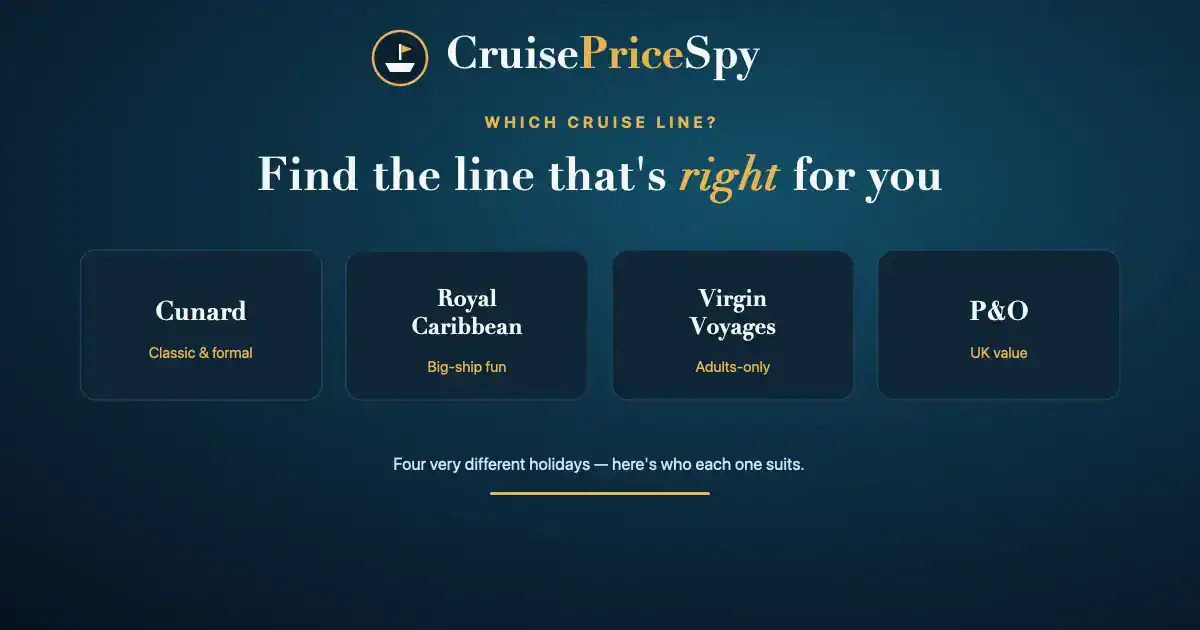
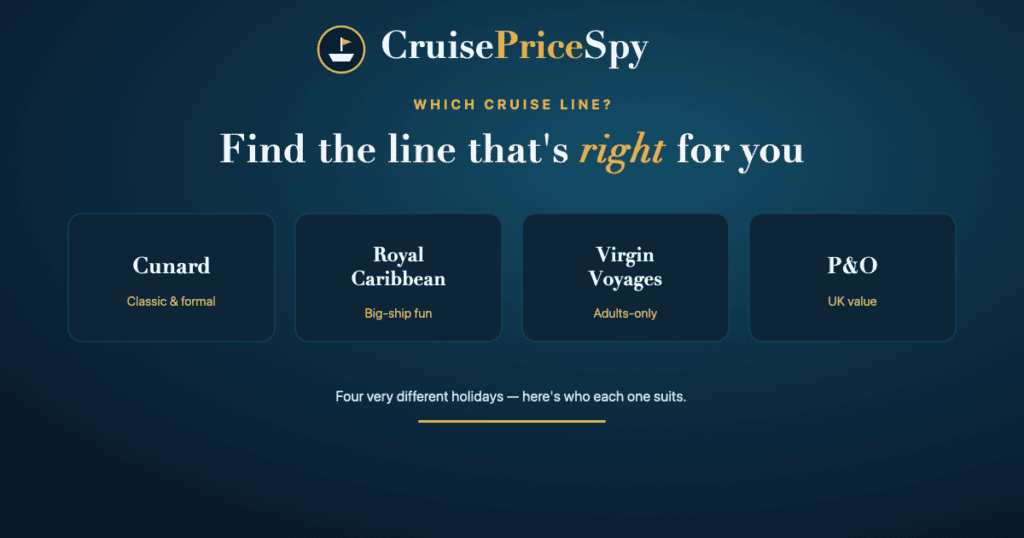
Not all cruises are the same holiday. The right line for a couple wanting black-tie dinners is the wrong one for a family chasing waterslides — or a group of friends after a grown-up party at sea. Here’s a plain-English guide to the four lines we track, and who each one suits.
Cunard — classic British elegance
Cunard is the grande dame of cruising: ocean liners, white-glove service, afternoon tea and proper black-tie “gala” evenings. The famous Queen Mary 2 still does genuine transatlantic crossings. Best for: couples and travellers who love tradition, refinement and a slower, more formal pace. Less ideal for: young families or anyone after a casual, anything-goes holiday.
Royal Caribbean — big ships, big fun
Royal Caribbean builds some of the largest, most feature-packed ships afloat — surf simulators, rock-climbing walls, ice rinks, waterslides and West End-style shows. There’s relentless choice for all ages. Best for: families and active travellers who want the ship to be the destination. Less ideal for: those seeking peace, quiet and intimacy.
Virgin Voyages — adults-only and stylish
Virgin Voyages threw out the rulebook: 18+ only, no formal nights, no buffets (proper sit-down restaurants instead), tattoo parlours, great music and tips included. It feels more boutique hotel than traditional cruise. Best for: couples and groups of friends who want a stylish, party-friendly, kid-free escape. Less ideal for: families, or anyone who loves cruising tradition.
P&O — great-value family cruising from the UK
P&O sails largely from UK ports (Southampton), so there’s no flight needed — a big saving and a stress-reducer. It offers familiar, well-priced family holidays with both family-friendly and adults-only ships in the fleet. Best for: UK families and first-time cruisers wanting value and convenience. Less ideal for: those chasing ultra-luxury or a more international crowd.
So which should you choose?
A quick rule of thumb:
Romance & tradition → Cunard
Families & non-stop activity → Royal Caribbean
Adults-only & style → Virgin Voyages
UK departures & value → P&O
The smarter move: compare them by value
Once you’ve shortlisted a line by style, choose your actual sailing by value. The cheapest headline price rarely tells the real story — a longer cruise can cost far less per night than a short one. That’s why we compare every sailing by Price Per Person Per Night (PPPN).
Our free tracker shows live prices across all four lines side by side, ranked by PPPN, with price-drop and lowest-yet flags so the best-value sailing rises to the top.
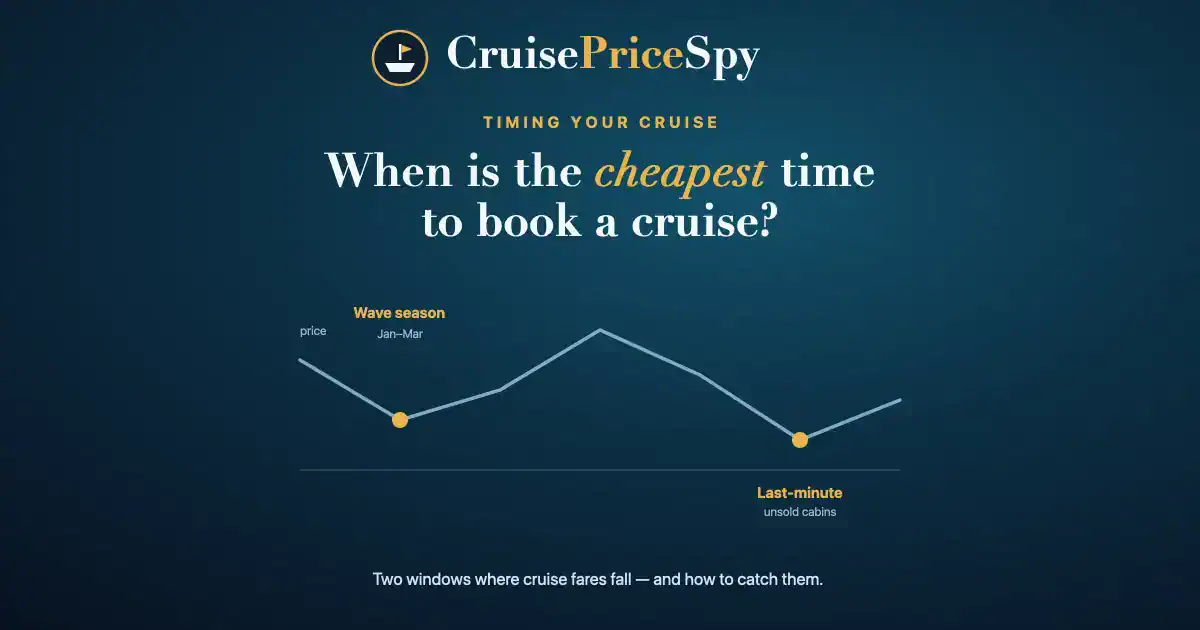
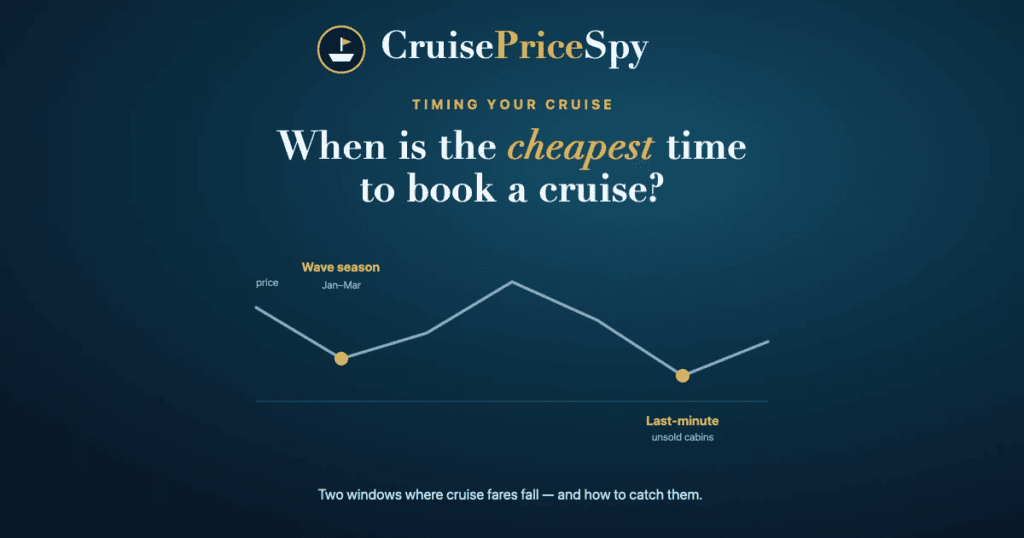
There’s no single “best day” to book a cruise — but there are clear windows where prices fall, and knowing them can save you hundreds. Here’s how cruise pricing actually works, and when to pounce.
Cruise fares move constantly
Like flights, cruises use dynamic pricing. The fare you see today isn’t fixed — it rises as a ship fills and drops when cabins sit empty. That means the same cabin can swing in price many times before sailing. The goal isn’t to guess the bottom; it’s to recognise a genuinely good price when it appears.
Should you book at launch?
Launch prices are often — but not always — excellent. The only way you’ll know if it’s a great price at the start, is to watch and learn over time. The down side to booking so far out is deposits, Check if they are refundable, in many cases they are not. We’ll talk insurance another time
“Wave season” — January to March
The cruise industry’s big sale period runs roughly January through March, known as wave season. Lines launch their best promotions of the year to fill cabins — think free drinks packages, onboard credit, reduced deposits, or kids-sail-free deals. If you’re planning ahead, this is prime hunting time.
Book early for choice, late for price
There are two sweet spots, and they suit different travellers:
Early (6–18 months out): the widest choice of cabins, dining times and itineraries, plus the best early-bird perks. Ideal for school holidays, suites, or a specific sailing you don’t want to miss.
Last-minute (within ~90 days): lines slash fares on unsold cabins to sail full. Brilliant value if you’re flexible on dates, cabin type and destination — less so if you need flights or specific dates locked in.
The squeeze in the middle (roughly 3–6 months out) is often where prices are highest.
Sail in the shoulder season
When you sail matters as much as when you book. Shoulder seasons — spring and autumn — usually undercut peak summer and Christmas sailings, often with better weather and quieter ships. A Mediterranean cruise in May or September can be dramatically cheaper than the same route in August.
Don’t be fooled by a “sale”
A countdown timer and a big red “SALE” badge don’t guarantee value. The only way to know if a price is genuinely good is to compare it against the Price Per Person Per Night (PPPN) for that route. If it’s below the typical PPPN, it’s a real deal. If not, it’s just marketing.
Rather than refreshing cruise-line sites and trying to time the market, let prices come to you. Our free tracker monitors live fares across Cunard, Royal Caribbean, Virgin Voyages and P&O, ranks them by PPPN, and flags genuine price drops and lowest-yet fares — so you catch the dip without the legwork.
Most people book the wrong cruise — and never realise it.
The fix is one simple number.
When you’re comparing cruises, the price you see is the total cabin price. But that number lies. A two-week cruise will always look more expensive than a long weekend — even when it’s far better value.
To compare fairly, you need PPPN: Price Per Person Per Night.
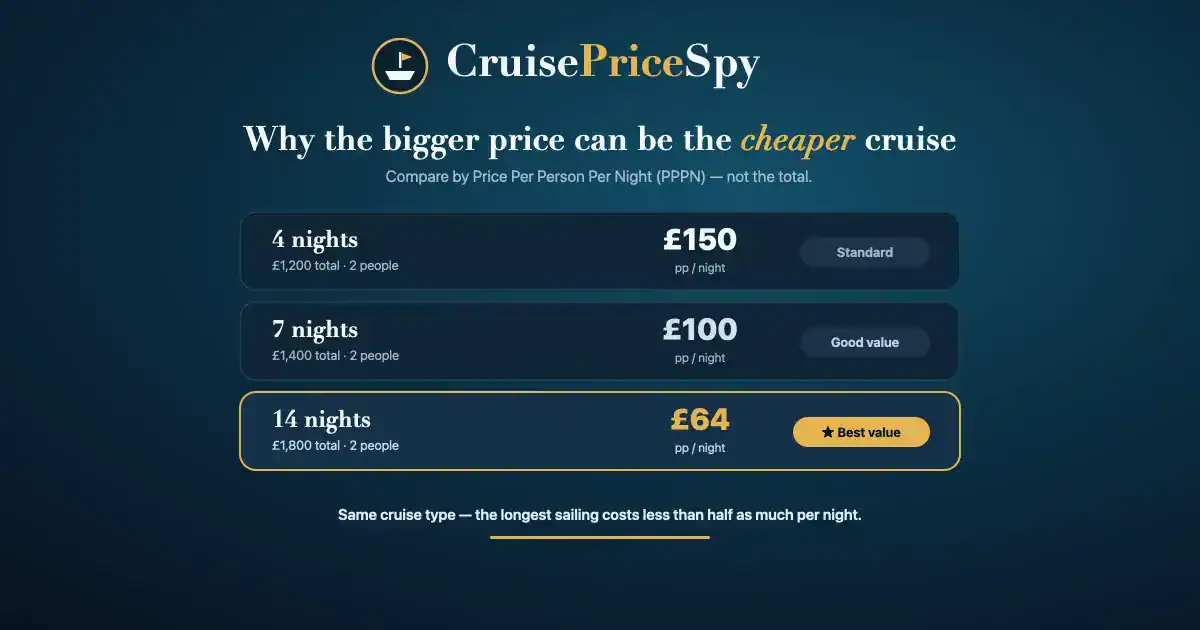
Why a £1,800 cruise can be better value than a £1,200 one
A £1,200 cruise for 4 nights works out at £150 per person, per night. An £1,800 cruise for 14 nights is just £64 PPPN — over 50% cheaper per day, despite the bigger headline price. Once you compare by the night, the real bargains jump out.
Cruise prices move like flight prices
Cruise lines use dynamic pricing — algorithms push fares up when a ship is filling fast and slash them when cabins sit empty. PPPN helps you see past the sticker price and spot when a fare has genuinely dropped.
How to tell a real deal from a fake discount
The trick is knowing the average PPPN for a route. Once you do, any price below it is a genuine saving — and any “sale” above it is just clever marketing. That benchmark is your instant sanity check.
What £90 a night actually buys you
At £90 PPPN, remember that includes your cabin, travel between destinations, five-star dining and nightly entertainment. Put like that, cruising makes land-based holidays look expensive.
See it for yourself
Our free tracker shows live prices across Cunard, Royal Caribbean, Virgin Voyages and P&O — sorted by PPPN so the best value rises to the top, complete with “price drop” and “lowest yet” flags.
We use cookies for analytics and affiliate tracking, which keep CruisePriceSpy free to use. You can accept or reject non-essential cookies. See our Cookie Policy.