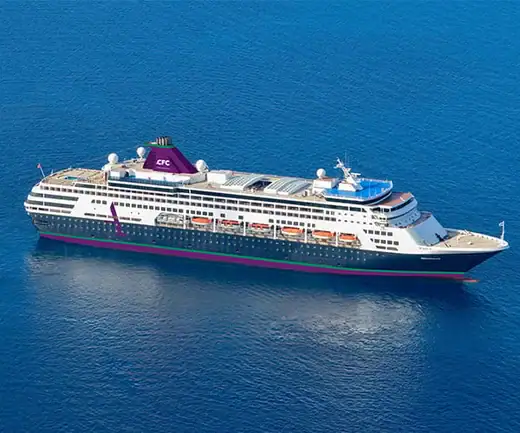
Author: CruisePriceSpy

  • The Cunard Cabin That Went From £217 to £90 a Night — Then Vanished By Morning

    The Cunard Cabin That Went From £217 to £90 a Night — Then Vanished By Morning

    We’ve been tracking Cunard prices every single day since we started. In the few weeks of watching, one thing has become impossible to ignore: the best prices don’t wait for you to notice them.

    If you’ve ever searched for a cruise, bookmarked a nice price, and come back a week later to maybe book it — you have probably already lost. Here’s what daily price-tracking has actually shown us, with real dates and real numbers.

    Proof the bargains are real

    These aren’t marketing prices. They’re what we watched Cunard actually charge, day by day, cabin by cabin.

    Case 1 — The £65 Inside cabin

    A 9-night Cunard repositioning sailing from Southampton (departing 10 Jan 2027) had its Inside cabin sitting at £65.00 per person, per night from 20 July through 24 July.

    On 25 July, it jumped to £80.20/night — a 23% rise overnight — and it’s stayed there ever since. Anyone who saw £65 and thought “I’ll book it later” will be paying more than they needed to.

    Case 2 — The 59% Balcony drop that lasted one day

    A Queen Victoria Balcony cabin (10 Aug 2026 departure) fell from £217.80 to just £90.10 per night — a 59% drop, the sharpest Balcony fall we’ve recorded on Cunard to date.

    It held for exactly ONE DAY and then rose to £146.60/night.

    4 days
    median lifespan of a genuinely cheap price
    1 in 6
    notably cheap prices are gone within a single day
    Daily
    how often can we realistically check, not that many, but we are here so you don’t have to

    That “4 days” figure is the median across every genuinely cheap Cunard price we’ve logged since we started tracking — not a cherry-picked example. HALF of the bargains we’ve seen were gone in under four days. Some lasted three weeks. Quite a few didn’t survive the night.

    Here’s one that’s still live right now

    🔔 Still tracking as live

    Queen Elizabeth · 6 Jan 2027 · 13 nights

    This is the one worth checking today, not next week. Every single cabin grade on this sailing is currently at the lowest price we’ve ever recorded for it — and it’s been sitting there.

    Inside
    £44.90
    Outside
    £50.80
    Balcony
    £56.10
    Suite
    £150.30

    Every price we quote above is per person, per night (PPPN). We can’t promise it’ll still be there when you read this — that’s rather the point of this article.

    So what do you actually do about it?

    You can’t watch Cunard’s prices every day. BUT NO WORRIES….. We already do — Our PRICE WATCH system exists to do exactly that, quietly, in the background, so a genuine drop doesn’t slip past you the way the £65 cabin above did for everyone who saw it and waited.

    Price Watch does one simple thing: tell it what you’re interested in — one specific sailing, or a whole type of cruise (say, any Cunard Balcony under a price you choose) — and we’ll email you the moment it’s worth a look. No refreshing search results at 11pm. No missing a price that only lasted a day.

    The honest bit: we’ve only been tracking Cunard prices recently — but already its obvious to us that, the “4 days” figure is a genuine, real read on what we’ve seen so far, but it’s early data, not a decade of pattern. We’ll keep this article and the stats behind it updated as more history builds up.

    Don’t let the next one get away

    Set a Price Watch on the cruise you’re eyeing — or on a whole category — and let us do the daily checking for you. Our services are FREE to use, so what have you got to lose. Answer, Nothing!…. but potentially you can save a lot.

    🔔 Set up your Price Watch →

    To set up a Price watch, Click Button above then Search for your cruise (region/dates/cabin) — results load in the tracker. Tap the ★ next to any sailing — that’s the “Price Watch this cruise.” A small form pops up — confirm cabin type and your target price (PPPN threshold, we’ll suggest a price for you). Hit “Create Price Watch” (or “Track this cruise” on the per-sailing version) — you’ll get a confirmation, then an email whenever a match/drop appears. That’s it — no account needed, just an email address in the form.

    Data: CruisePriceSpy’s own daily Cunard price tracker. Snapshots taken daily. Prices shown are cruise-only, per person, per night, correct as tracked at the time of writing and subject to change.

  • Cruise Luggage After Back Surgery: Have Marella and Ambassador Taken the Weight Off?

    Cruise Luggage After Back Surgery: Have Marella and Ambassador Taken the Weight Off?

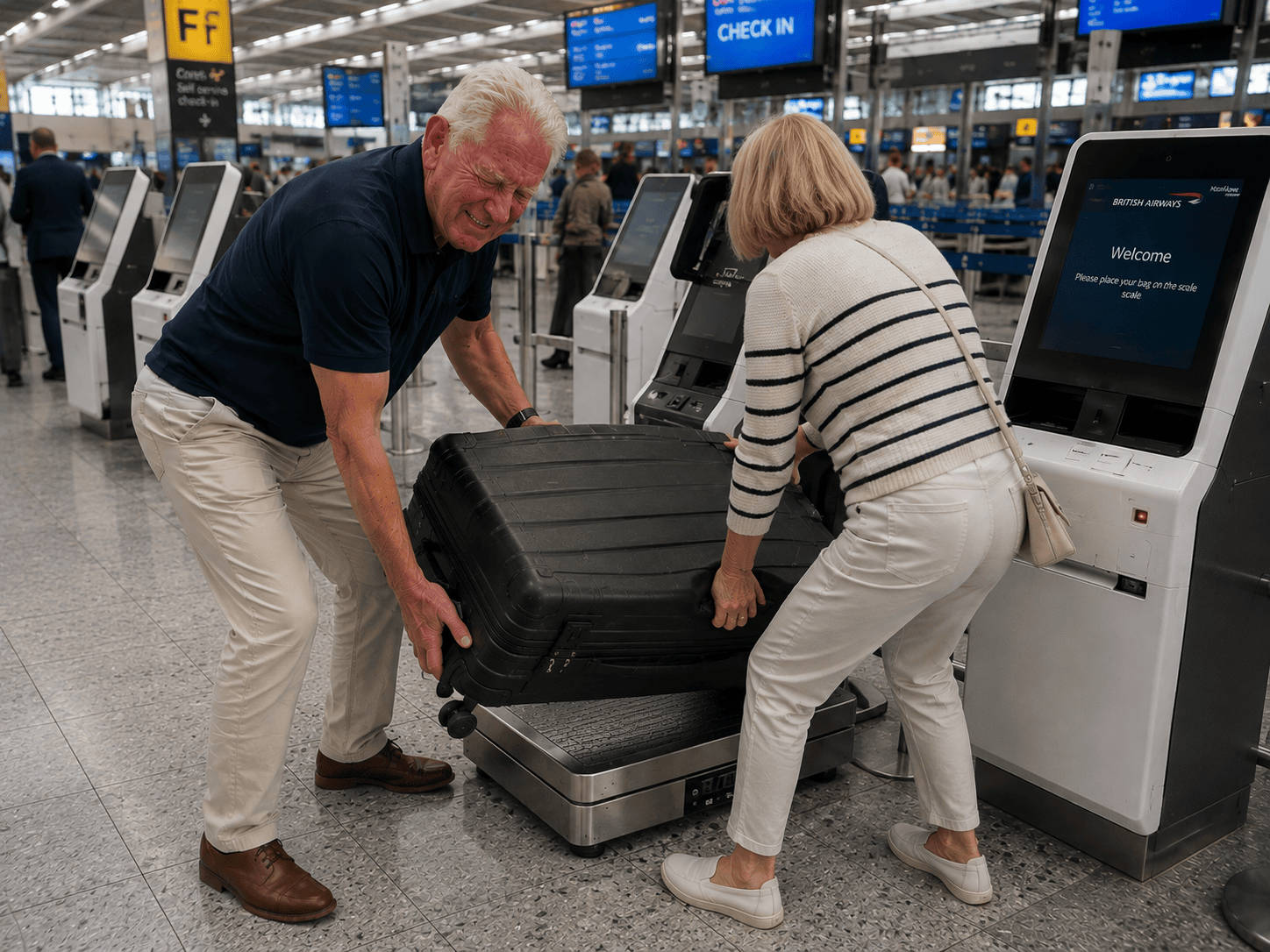
    Three years after back surgery, I still can’t watch my wife drag a suitcase off a carousel without wincing. Not from the case. From what I know it costs her.

    In over 60 years of cruising, one of the hardest parts for me — especially as I get older — is lugging huge, heavy suitcases around airports. Dragging them off carousels. Hauling them across cobbles. Anything to do with luggage, if I’m honest, stresses me out at the best of times, and at the worst of times leaves my back feeling what I’ve started calling “edgy,” ever since serious back surgery nearly three years ago. Disc problems and decompression surgery are not fun, and luggage has a real ability to undo three years of improvement in about thirty seconds flat.

    Luggage Forward door-to-door cruise luggage shipping logoI’ve tried the firms who’ll collect your cases from home and land them in your cabin for you — services like Luggage Forward, who ship door-to-door straight to your stateroom, anywhere in the world. It works, but it’s expensive, and it means packing seven to nine days before you’ve even left — which for us means half the clothes need serious ironing or pressing by the time we arrive, because nothing survives that long folded in a case looking fit to wear.

    Send My Bag luggage shipping logoThere are lower-cost general shippers too, like Send My Bag, who’ve been doing doorstep-to-destination luggage shipping since 2006 and work on a flat rate rather than a premium white-glove price — a reasonable middle ground if full home collection feels like too much to pay for a case you could otherwise carry yourself, given a helping hand.

    I hate watching my wife drag a case off a carousel and let it thud to the ground in frustration. So I posted a brief description of what I was writing about into nine different Facebook cruise groups, asking how the rest of you handle it — luggage, ageing bodies, bad backs, dodgy hips, the lot. I wasn’t expecting quite the response I got. Before I get to what Marella and Ambassador are doing, which is genuinely worth covering, I want to share what came back, because I’ve included many of the incredibly helpful suggestions in this article — and between you, you’ve worked out more good solutions than either of those two cruise lines have.

    Jump to a section:

    The no-fly option: drive straight to the port
    Paid porter and luggage delivery services
    Airport assistance schemes worth knowing
    Packing lighter, properly
    Not alone in this
    What Marella actually does well
    Does Ambassador do the same from Manchester?
    The honest comparison
    A hope for the rest of the industry

    What you actually told me

    The no-fly option: drive straight to the port

    Several of you pointed out that the simplest fix is sidestepping the airport altogether.

    Nigel S. put it plainly: “This is one of the reasons we only cruise Southampton to Southampton, not fly/cruise, so we can drive to the port where the porters take the luggage from your car, then take the car, and you simply walk into the terminal.”

    Adrian I. does the same with Cunard: “We tend to take no-fly options, not only for getting rid of the hassle of bags, but the airports and possibly delays as well. With Cunard we get a taxi to the hotel at the bus pick-up point… then it’s goodbye bags until we go to our cabin.” He also flagged something I hadn’t considered — no-fly repositioning cruises, like Queen Mary 2 to New York, then a separate Caribbean sailing out of New York, with a repositioning cruise back home to finish.

    Roger F. summed up the appeal in six words: “We don’t fly anymore. Coach to Soton and return. Porters at both ends. No lifting.”

    Paid porter and luggage delivery services

    CPS Cruise and Passenger Services logoA few of you have found genuinely good middle-ground options between doing it all yourself and full home collection.

    Sandra R.: “Parking with CPS at Southampton is fantastic, no need to lift anything — drive to the port and they do the rest for you. Porter will take luggage back to your car for a small tip.” She also mentioned using Great Rail Journeys’ luggage service with an Apple AirTag tucked in the case, so she always knew where it was.

    Pat A. made a point I needed to hear: “We think the baggage handling service is money well spent. Stress-free and saves the back before the holiday starts. We still take one case with us, but pack much lighter than we used to. No-one cares if you wear the same outfit twice.”

    Airport assistance schemes worth actually knowing about
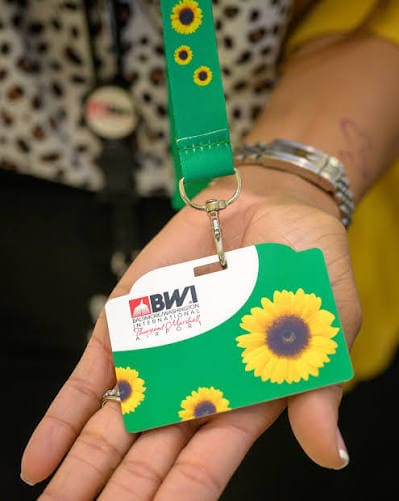
    Sunflower lanyard hidden disability assistance schemeThis is the section I learned the most from. Carol Ann L. explained the formal route: “At airports, you should ask for Special Assistance or Reduced Mobility (PRM) service at your airline’s check-in desk or customer service counter. You can request help with carrying bags, pushing your cart, or moving through security and to your plane seat.”

    Jacqueline S. told me about something I genuinely hadn’t heard of, and I suspect a lot of you haven’t either: “Something that not many people are aware of is the sunflower lanyard programme. These can be collected at no charge at most major airports and train stations. Staff have been trained to be on the lookout for the lanyard, as it alerts them that this person has a disability, hidden disability, or requires assistance.” She’d pre-booked mobility assistance online for her elderly parents’ train and flight bookings at no extra cost, and said it made a genuine difference.

    Packing lighter, properly

    More than a few of you made the point I’ve been dodging: the lightest case is the one you never fully packed in the first place.

    Rosemary S.: “Pack less. It took me some time, but we’ve now gone from 23kg to 15kg and can go on a non-cruise week-long holiday with a 10kg bag each.”

    Melissa A. put it in four words: “Smaller suitcase. Less stuff.”

    Jillian K. had a proper system: “I tend to pack outfits to mix and match, to keep contents down, which removes a lot of weight, and just add accessories with bling. Minimise, minimise, minimise. Packable down coats that roll up to as big as your hand.”

    And Gary P. left the tip that made me laugh in recognition: “Airports have trolleys, always use them for large cases… And yes, take less! Do you really need a different dress or suit every day? No-one notices what you wear, honestly!”

    Not alone in this

    A reply from Diane P. stopped me in my tracks a bit, in a good way: “My husband has had decompression surgery plus fusion surgery and still has ongoing back issues. My back isn’t brilliant either. Considering shipping cases to the ship next year, but as you say it’s expensive, so I’m interested in different options.”

    Reading that, I don’t feel quite so much like the odd one out with a case-shaped grudge against my own spine.

    So where do Marella and Ambassador fit into all that?

    All the approaches above have one thing in common: they’re workarounds. Clever, hard-won, genuinely useful workarounds — but things you have to organise yourself, on top of everything else that goes into planning a cruise. What made me sit up recently is that two cruise lines are starting to build a version of “don’t touch your bags again” directly into the fare itself, rather than leaving you to engineer it. So here’s what Marella, and now Ambassador in a smaller way, are actually offering — and how they genuinely compare to each other.

    What Marella actually does well

    Marella Cruises logoMarella’s fly-cruise model leans heavily on what’s called “bonded” luggage. On a bonded itinerary — common on the Caribbean routes — you hand your case over at check-in at your UK departure airport, and the next time you see it, it’s outside your cabin door. No baggage carousel, no dragging a case onto a transfer coach yourself.

    It’s worth being precise here, because it’s not universal across every Marella sailing. Some itineraries aren’t bonded, in which case you do collect your own luggage at the destination airport and hand it to the coach driver yourself — an extra step, though still a long way short of arranging your own transfers. Marella is upfront about which applies before you book, so it’s not a nasty surprise on the day.

    The other genuine strength is breadth of regional departure airports. Marella flies from a wide spread of UK airports rather than routing everyone through Heathrow or Gatwick, which is a real advantage if you’re not within easy reach of a major hub — Manchester, Bristol, Bournemouth, Belfast and others all feature across its programme, spread across four ships and a wide range of itineraries.

    So does Ambassador do the same from Manchester?

    Ambassador Cruise Line logo


    Partly — but it’s a narrower offering, and worth understanding exactly how it differs before assuming it’s a like-for-like match.

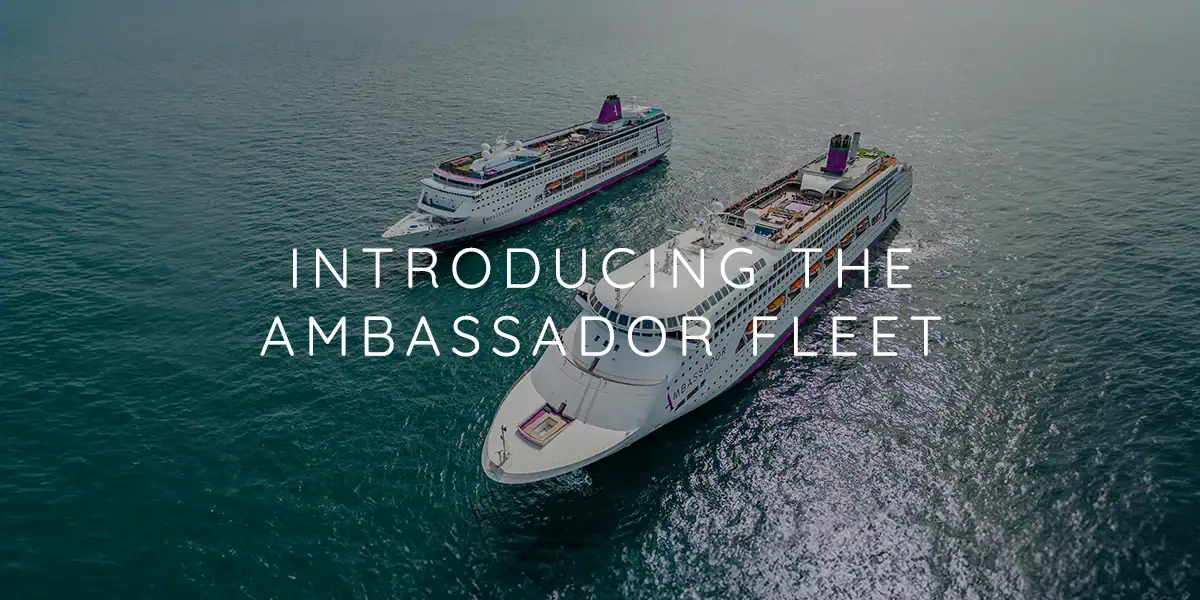
    Ambassador’s core identity is actually the opposite of a fly-cruise line. Ambience and Ambition, the line’s two established ships, are built around no-fly cruising — sailing directly from UK regional ports such as Tilbury, Liverpool, Newcastle, Bristol, Dundee, Belfast and Falmouth. For those two ships, there’s no airport at all, which sidesteps the entire “embarkation anxiety” question in a different way: no flight to worry about in the first place.

    The fly-cruise element is new, and it lives specifically on the newest ship, Renaissance, running Caribbean itineraries. Ambassador’s Caribbean fly-cruises do depart from Manchester — alongside Heathrow — flying with Virgin Atlantic on A330neo aircraft, and the fare includes transfers between the airport and the ship once you land in Barbados. So yes, if you’re specifically booking a Renaissance Caribbean sailing, Manchester is a genuine, confirmed departure option.

    What’s genuinely reassuring is that Ambassador’s luggage handling on this route matches Marella’s bonded promise almost exactly. Check your case in at Manchester with the cruise luggage label attached, and it goes straight to your cabin on Renaissance — you don’t see it again until it’s there waiting for you. That’s confirmed directly by Ambassador, not just implied.

    Manchester also has a genuine edge worth knowing about: the airport’s Twilight Check-In service lets you check in, drop your labelled luggage and collect your boarding card the evening before your flight (4pm–8pm), so departure morning itself is just walking straight through to departures with nothing to carry. It’s a small thing, but it’s exactly the kind of friction Marella’s model is built to remove too.

    The honest comparison

    Number of regional airports: Marella’s fly-cruise programme spans a genuinely wide network of UK airports across its whole fleet. Ambassador’s fly-cruise option currently runs from two — Manchester and Heathrow — and only on Renaissance’s Caribbean season.

    Luggage handling: Marella explicitly promises bonded luggage on many of its itineraries — check in and don’t see your bag again until it’s at your cabin. Ambassador makes the same promise on its Manchester–Barbados route: label it, check it in, and it goes straight to your cabin on Renaissance. On this specific route, the two lines are genuinely matched.

    Ships this actually applies to: Marella’s model runs across its whole fleet. Ambassador’s fly-cruise model currently applies to one ship out of three, for one region.

    If you don’t want to fly at all: This is where Ambassador genuinely has the edge over Marella — Ambience and Ambition offer true no-fly cruising from UK ports, which removes the whole airport question rather than just streamlining it.

    The real takeaway

    Marella built its reputation on solving fly-cruise anxiety at scale, across a wide network of regional airports and the bulk of its fleet. Ambassador is newer to this game and currently offers it from just Manchester and Heathrow, on a single ship’s Caribbean season — but where it does offer it, the luggage promise genuinely matches Marella’s: label it, hand it over, don’t think about it again until it’s in your cabin.

    The real difference, then, isn’t the quality of the experience on the route Ambassador does offer — it’s the breadth. Marella spreads this ease across many airports and most of its fleet. Ambassador currently offers it on one route, alongside something Marella doesn’t have at all: genuine no-fly cruising on its other two ships, for anyone who’d rather skip the airport question entirely.

    A hope for the rest of the industry

    Reading through everyone’s comments, one thing became obvious: this isn’t a niche problem. Back surgery, hip replacements, dodgy knees, ageing bodies that just don’t do what they used to — a huge number of us are dealing with some version of this, and most of us have had to find our own workaround, whether that’s a paid porter, a no-fly booking, or simply packing lighter out of necessity rather than choice.

    So here’s a genuine hope, not just for me but for everyone who commented: that other cruise lines are watching what Marella and Ambassador are doing and start offering the same thing. Bonded luggage isn’t complicated technology — it’s a label, a system, and a bit of coordination between airport and ship. It doesn’t need to be exclusive to a handful of Caribbean sailings on one ship. Every fly-cruise line could offer it, on every route, and it would make a genuine difference to an awful lot of people who currently have no choice but to drag a case through an airport themselves, or pay handsomely for the privilege of not doing so.

    Cruising skews older by nature, and that’s not going to change. If anything, it’s the entire reason this industry exists in its current form. The lines that work out how to make the physical parts of a fly-cruise genuinely easier — not just marketed as easier — are the ones that’ll earn real loyalty from people like us. I’d love to write a follow-up post in a year or two naming five or six lines doing this well, rather than two.

    If you’ve got a tip that isn’t above, drop it in the comments — I read every one.

    Before you book either

    Wherever you land — a Marella fly-cruise from Manchester or an Ambassador sailing, flown or otherwise — the same rule holds: work out the true price per person, per night, including everything the fare does and doesn’t cover, before comparing headline prices.

    We track live prices across both these lines and thirteen others, ranked by true price per person per night, so you can see honestly which option suits your budget as well as your travel preferences.

    Compare live cruise prices at cruisepricespy.com/ →


    Steve & Gill have been cruising for over 60 years and has spent 40 of them in hospitality and tourism. They met on SS Canberra cruise ship in 1975 and haven’t stopped sailing since.

  • Ambassador Cruises: An Honest Guide to the Fleet

    Ambassador Cruises: An Honest Guide to the Fleet

    Ambassador Cruises is one of the newer names in British cruising, but don’t mistake newer for untested. The line launched in 2022 with a straightforward pitch: mid-size, adults-focused ships, a proper British sensibility, and none of the mega-ship scale that puts a lot of cruisers off. Three ships now make up the fleet, and each one has a genuinely different character worth knowing before you book.

    Here’s what each ship actually gives you, what the facilities are really like once the marketing gloss is stripped away, and where the new Caribbean fly-cruise programme fits in.

    The fleet at a glance

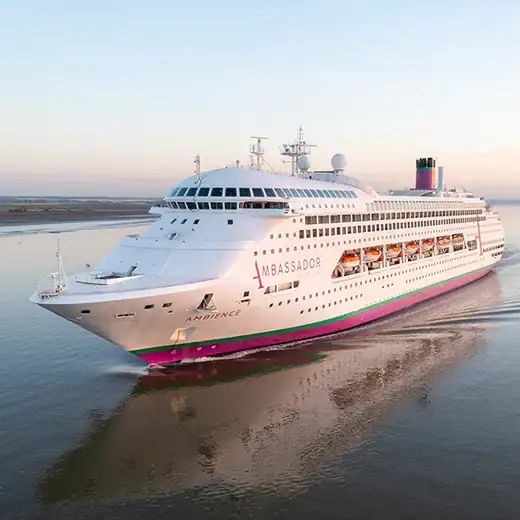
    Ambassador Cruises Ambience ship at sea

    Ambience is the largest of the three — 1,400 guests across 789 cabins, 11 guest decks, and 9 lifts. Built in 1991 and refitted as recently as 2022, she’s the ship in the fleet with the most space to spread out, both in cabin choice and in the range of lounges and dining venues on board.

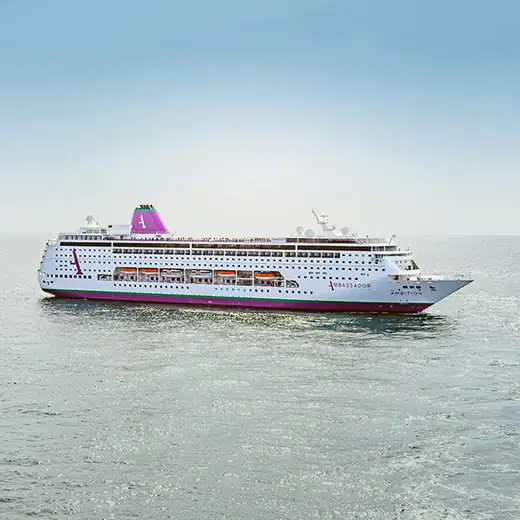
    Ambassador Cruises Ambition cruise ship

    Ambition sits just below her sister ship in size — 1,200 guests, 680 cabins, 10 decks, 6 lifts. Built in 1999 and refitted in 2023, she carries the same Ambassador feel in a slightly more compact package, which for some cruisers is exactly the point: shorter walks, an easier ship to learn in the first day, and a genuinely intimate atmosphere once you’re a couple of days in.

    Ambassador Cruises Renaissance ship, sailing the new Caribbean fly-cruise programme

    Renaissance is the newest addition and the odd one out in the best possible way. Smaller again at 1,100 guests and 629 cabins across 9 decks, built in 1992 and given a full refit as recently as 2025, she’s been brought into the fleet specifically to run a new programme of fly-cruises to the Caribbean — meaning you fly out to join her rather than sail the Atlantic crossing to get there. If the idea of Caribbean cruising has always appealed but the thought of days at sea each way hasn’t, this is the ship built to solve exactly that problem.

    What the ships are actually like on board

    Every Ambassador ship carries a similar spread of venues, though the exact line-up varies slightly by ship. A few worth knowing about:

    Bartender preparing a cocktail at Raffles Bar on an Ambassador Cruises ship

    For a drink, there’s real variety rather than one generic ship’s bar. Expect something properly dressed-up for an evening cocktail, a speakeasy-style spot for something with more theatre to it, and — genuinely unusual for a cruise ship — a proper British pub on board, which is either exactly what you want after a week away or entirely beside the point, depending on the cruiser.

    For dining, the main buffet-style venue draws on cuisines from around the world rather than sticking to one theme, and it’s backed up by a handful of speciality restaurants you’ll want to book early: a multi-course tasting menu experience, a fusion restaurant, a Mediterranean-leaning spot, and one built specifically around seafood and produce from the land side of the menu too. Worth checking whether your chosen ship’s speciality dining is included in the fare or charged separately before you compare prices against another line — this varies more than you’d expect between cruise lines and can quietly move the real cost of a holiday.

    Beyond eating and drinking, there’s a casino, a spa and gym, a craft studio if you fancy something more hands-on than a sun lounger, a library, and the usual salon and shopping options. Top deck, you’ll find the pool and hot tubs that most cruisers actually spend the bulk of their sea-day time in, whatever else the brochure highlights.

    Who Ambassador actually suits

    This is a genuinely adults-leaning fleet with a distinctly British character, and it tends to suit cruisers who’ve found the biggest ships on the market a bit much — too many people, too much queuing, too much noise — without wanting to trade all the way down to a tiny boutique ship with limited facilities. Ambience and Ambition both sit comfortably in that middle ground.

    Renaissance is worth a specific mention on its own terms. If the Caribbean has always been the itinerary you wanted but the transatlantic crossing was the sticking point, the new fly-cruise programme is a genuinely different proposition to what the line’s other two ships offer, and worth comparing on its own merits rather than assuming it’s simply a smaller version of the same holiday.

    Before you book with any line, not just this one

    Whichever ship or line catches your eye, the same rule applies every time: work out the true price per person, per night, once you’ve added back anything not included in the headline fare — gratuities, drinks, speciality dining, excursions — and compare it honestly against what else is out there.

    Our free tools do exactly that. We track live prices across fifteen cruise lines, including Ambassador, ranked by true price per person per night rather than the headline total, so you can see straight away whether a particular sailing is genuinely good value or simply well marketed. If you’ve already been sent a quote, run it through our Deal Checker for a second opinion before you commit.

    Compare live cruise prices at cruisepricespy.com/ →


    Steve has been cruising for over 60 years and has spent 40 of them in hospitality and tourism. He and Gill met on a cruise ship in 1975 and haven’t stopped sailing since.

  • Disembarkation Day: The Night Before, The Morning Of, and Why It All Runs Like Clockwork

    Disembarkation Day: The Night Before, The Morning Of, and Why It All Runs Like Clockwork

    Embarkation day is the one everybody talks about. Disembarkation day is the one that catches people out.

    It’s the day with the tightest clock on the whole cruise, and the odd thing is that it almost always works. Two or three thousand people, ten thousand suitcases, one gangway, and by lunchtime the ship is spotless and boarding a completely new set of passengers. I’ve watched it happen for decades and it still impresses me.

    The passengers who find it stressful are usually the ones who did all their thinking on the morning. The ones who find it easy did fifteen minutes of thinking the night before.

    Here’s how it actually works, and what to do at each stage.

    The night before

    Read the disembarkation notice properly

    On the second-to-last evening, a letter appears in your cabin. Most people glance at it. Read it. It tells you three things that matter: what time cabins must be vacated, what time your luggage needs to be outside the door, and how the colour-coded groups work.

    Everything else that day flows from those three lines.

    Understand the coloured luggage tags

    You’ll be given tags in a colour or a number. This is the bit people misread. The colour isn’t really about when you get off the ship — it’s about where your suitcase sits in the terminal luggage hall the next morning.

    All the yellow cases go in one bay, all the blue in another. When you walk into that enormous hall, you go straight to your colour and there’s your case. That’s the whole trick, and it’s why the system exists.

    Two practical points. First, put a tag on every case, and make sure everyone in your party has the same colour if you want to leave together. Second, if the time you’ve been given doesn’t suit — an early flight, a long drive, a late train — go to guest services and ask to change it. They will almost always say yes if you ask a day early. They can rarely help at 7am on the morning.

    Decide whether to carry your own bags

    Most lines now offer self-assist, sometimes called walk-off or express disembarkation. You keep your cases in the cabin overnight, carry them off yourself, and you’re usually first ashore — often before 7.30am.

    It’s brilliant if you travel light, have an early flight, or hate waiting. It’s miserable if you’ve got four large cases, a family, and a staircase between you and the gangway. Lifts are rammed on disembarkation morning. Be honest about how much you’re carrying.

    Pack the night before, but not everything

    The classic mistake, and I’ve made it: your cases go outside the door at 10pm with tomorrow’s clothes inside them.

    Keep out: what you’re wearing in the morning, nightwear, toiletries and medication, passports and travel documents, phone and chargers, glasses, valuables, and anything you’d hate to be separated from. Everything else goes in the case.

    Cases usually go outside the cabin door between about 8pm and 11pm — check your letter. Once they’re gone, they’re gone until the terminal.

    Settle the small stuff

    Check your onboard account on the TV or app. Any charge you don’t recognise is far easier to sort out at 9pm than in a queue at 7am. Confirm your gratuities are as you want them, close down any internet package if it’s billed by the day, and pick up anything you’ve left in the safe, the laundry, or the photo gallery.

    If your steward or waiter has looked after you well, the last night is the moment to say so. A thank you costs nothing and it’s the part of the day they remember.

    Sleep, and check the clocks

    On repositioning and transatlantic voyages the clocks often change on the last night, and there’s always someone at breakfast who missed it. Have a quick look at the daily programme before bed.

    The morning of

    Cabins close early

    You’ll usually be asked to vacate your cabin by around 8am. That isn’t the ship being awkward — the stewards have a matter of hours to strip, clean and reset every cabin before the next passengers walk on. Take your hand luggage and go.

    Breakfast is earlier and busier

    Buffets and dining rooms open earlier than usual on the last morning, and they get very full very fast. Eat early if you can, and don’t rush it — you’ll almost certainly have waiting time afterwards, and it’s more pleasant to spend it fed.

    Wait somewhere comfortable

    This is the single best decision of the morning. The ship allocates lounges, theatres and bars as waiting areas by group. Go to yours, take a seat, get a coffee, and stay there.

    What you must not do is join the queue on the stairs. Every ship has a crowd of people standing in a stairwell with their bags for forty-five minutes, going nowhere, blocking everyone else. They do not get off any earlier. Not one of them.

    Listen for your group

    Announcements come thick and fast, and colours are called in order as the terminal clears. When yours is called, walk down, scan your card at the gangway one final time, and you’re ashore.

    The luggage hall

    Head straight for your colour. Cases are laid out in bays and porters are on hand if you want help — a tip is customary in most ports and worth it if you’re loaded up.

    Then it’s immigration and customs, which varies enormously by country. In most European ports it’s a walk-through. In the US it’s a proper passport check, though facial recognition has made it much quicker than it used to be.

    And then you’re outside, blinking in a car park, holiday over.

    So why does it run so smoothly?

    Because it has to. The ship has a fixed slot in that port, and in the same working day it must land several thousand passengers, take on stores and fuel, complete a full turnaround clean, and board several thousand more — many of whom are already sitting in the terminal watching you leave.

    Everything you experience is designed backwards from that deadline. The coloured tags, the early cabin deadline, the staggered groups, the overnight luggage collection — none of it is bureaucracy for its own sake. It’s the only way the maths works.

    Once you see it that way, the day stops feeling like being hustled off and starts feeling like watching a genuinely impressive operation. Which it is.

    Five things worth knowing

    • Late flight? Ask about late departure options. Many lines let you stay on board later, and some sell a day-use lounge or an escorted tour that ends at the airport.
    • Early flight? Don’t book anything before late morning. Delays at the port are rare but not unheard of, and a missed flight ruins a good holiday retrospectively.
    • Luggage valet is offered in some US ports — your cases go straight through to your final airport and you don’t see them again until you land. Superb when it’s available.
    • Go up on deck for the arrival if you’re awake. Coming into port at dawn is one of the best sights in cruising and hardly anybody bothers.
    • The disembarkation talk on the last sea day is genuinely useful, especially in an unfamiliar port. It’s usually also broadcast on your cabin TV.

    One last thing before you go home

    Somewhere in that final week, someone from the future cruise desk will have offered you a deposit on your next sailing. Onboard offers are often good — low deposits, extra credit — but “good” and “the best price available” aren’t always the same thing.

    Before you commit, take thirty seconds and run the quote through our free Deal Checker. It converts any cruise quote into a true price per person per night and tells you honestly whether it beats what’s out there. Do it while the holiday feeling is still fresh, not after you’ve paid.

    Check your cruise quote free at cruisepricespy.com/ →


    Steve has been cruising for over 60 years and has spent 40 of them in hospitality and tourism. He and Gill met on a cruise ship in 1975 and haven’t stopped sailing since.

  • Embarkation Day: What You Expect, What Actually Happens, and How to Spend Your First Hour On Board

    Embarkation Day: What You Expect, What Actually Happens, and How to Spend Your First Hour On Board

    Embarkation day is the strangest day of any cruise. You’ve waited months for it, you’ve counted down the sleeps, and then you spend the first three hours of it standing in a queue holding a passport and a slightly damp boarding pass.

    I’ve done it more times than I can count — the first one back in the seventies, the most recent one this summer — and the pattern is remarkably consistent. The people who enjoy embarkation day aren’t the ones who got lucky. They’re the ones who knew what was coming.

    So here’s the honest version: what you think will happen, what actually happens, and exactly what to do with your first hour once you’re on board.

    What you expect embarkation day to be like

    Be honest. In your head it goes something like this.

    You arrive at the terminal at a civilised hour. A smiling man in a cap takes your suitcase. You walk through security, someone photographs you, and within twenty minutes you’re stepping onto a gleaming ship where a waiter hands you a glass of something cold. You wander to your cabin, the bags are already there, you unpack at your leisure, and by two o’clock you’re on the top deck watching the port slide away.

    That version does happen. Occasionally. Usually to people who board late on a small ship in a quiet port.

    The rest of us get the real version, which is honestly fine once you’re expecting it.

    What actually happens on embarkation day

    Your boarding time is real — mostly

    Nearly every cruise line now gives you a staggered boarding slot, usually chosen at online check-in. Take it seriously. Turning up two hours early doesn’t get you on two hours early; it gets you a plastic chair in a shed. Turning up at your slot, or fifteen minutes after it, usually gets you straight through.

    The exception is the very first slot of the day. Those passengers often wait longest, because the ship isn’t cleared yet. If you want the smoothest run, take a mid-afternoon slot and arrive relaxed.

    The terminal is the worst bit, and it’s over quickly

    Luggage drop happens outside or just inside the door. Porters take your cases, which then disappear into the ship’s belly and reappear outside your cabin door anywhere between one and six hours later. That’s the single most important thing to understand about embarkation day, and I’ll come back to it.

    Then it’s security — same as an airport, minus the shoes — followed by check-in, where they scan your documents, take your photo, and either hand you a cruise card or tell you it’s waiting outside your cabin.

    Realistic timings: on a small ship in a quiet port, fifteen minutes. On a 5,000-passenger ship in Barcelona or Southampton in peak season, an hour is normal and ninety minutes isn’t a disaster.

    The gangway moment

    This is the good bit. You walk up, they scan your card, someone says your name, and you’re on. Most lines take a photo here. Smile or don’t — nobody’s making you buy it.

    You’ll usually step into a bright atrium with a lot of noise, a lot of glass, and staff pointing in different directions. This is where most people make their first mistake: they head straight for the cabin.

    Cabins often aren’t ready

    On most ships, cabins are released somewhere between 1pm and 3pm, and there’s usually an announcement. If you go straight there, you’ll find a corridor full of trolleys and a stewardess who quite reasonably wishes you weren’t there yet.

    Your luggage is not lost

    By four o’clock, someone in your party will say the bags haven’t arrived and something has gone wrong. Nothing has gone wrong. Cases are delivered in waves and the last ones can land as late as dinner time. If yours hasn’t appeared by around 6pm, then it’s worth a polite word at guest services — but before that, it’s simply the system working normally.

    The muster drill

    Safety drill is compulsory and it happens before sailing. Most lines have moved to the sensible version: watch a video on your phone or cabin TV, then check in at your muster station where a crew member scans your card. Five minutes, done. A few ships still do the full assembly. Either way, do it early — they will chase you over the tannoy by name, and it’s a poor way to start a holiday.

    Sailaway

    Then the ropes go, the horn sounds, and the port starts moving backwards. This is the moment the holiday actually begins, and it never gets old.

    Your first hour on board: what I actually do

    Here’s the routine. It’s built from a lot of embarkation days, and it turns the awkward two-hour gap between boarding and cabin-opening from dead time into the most useful hour of the cruise.

    1. Carry a day bag, and pack it properly.
    Swimwear, sun cream, medication, a change of shirt, chargers, and your documents. This is the single best embarkation-day habit there is. It means the luggage delay stops mattering at all.

    2. Eat somewhere that isn’t the buffet.
    Everyone piles into the main buffet at noon. Almost every ship also has a quieter lunch option open on day one — a pub, a grill, a bistro, sometimes even a main dining room. Ask at the gangway which venues are serving. You’ll eat better and hear yourself think.

    3. Book the things that sell out.
    Speciality restaurants, the spa thermal suite, shore excursions, and any show that needs reserving. Day one, first hour, is when availability is at its best. By the second sea day, the good tables are gone.

    4. Sort the drinks package question now.
    If you’re undecided, most lines let you buy on board on day one, sometimes at a small discount. And if you bought in advance and you’re now not sure, day one is usually the only day you can cancel or change it. Do the sums before you sail so you’re not deciding over a cocktail.

    5. Walk the ship.
    Twenty minutes, top deck to bottom. Find the lifts you’ll use, the quiet bar nobody’s discovered, the deck-11 door that’s the shortcut to breakfast. Ships are far easier to learn on day one when you’ve no reason to hurry.

    6. Check your account and your cards.
    Confirm your card is linked to the right payment method and, if you’re travelling as a family, that the children’s cards have the drinks and spend limits you asked for. Sorting it now takes two minutes. Sorting it on day four takes a queue.

    7. Find your dining arrangement.
    If you have a fixed table, go and look at it. If you’re on flexible dining, book your first couple of nights. And if you’ve been given a table you don’t like the look of, the maître d’ is at his most flexible on the first afternoon.

    8. Then stop.
    Get a drink, find a rail, and watch the port. You’ve done the useful part. The rest of the day is yours.

    The mindset that makes it easy

    Embarkation day rewards low expectations and a good day bag. It is a logistics operation involving several thousand people, and for about three hours you are a small part of a large machine. Then the machine finishes, the ropes go, and you get a week or two of being looked after.

    Expect a queue. Expect your bags to be late. Expect the cabin to open later than you’d like. Do those three things and it’s one of the best days of the trip.

    Before you book: know what you’re actually paying

    One last thought, because it’s what we do here. The cruise that starts with the smoothest embarkation day is often the one you booked calmly, at a fair price, without the last-minute panic of wondering whether you overpaid.

    Our free Deal Checker takes any quote you’ve been given and turns it into a true price per person per night, then tells you honestly whether it’s a good deal, a fair one, or one you can beat. It takes about thirty seconds.

    Check your cruise quote free at cruisepricespy.com/ →


    Steve has been cruising for over 60 years and has spent 40 of them in hospitality and tourism. He and Gill met on a cruise ship in 1975 and haven’t stopped sailing since.

  • The Ocean Edit: The First-Time Cruiser’s Guide by @thevelvetnotebook_

    The Ocean Edit: The First-Time Cruiser’s Guide by @thevelvetnotebook_

    July 2026

    First Time Cruising? Start Here.

    Booking your first cruise can feel like a lot — muster drills, tender ports, drinks packages, dress codes, all the little unwritten rules nobody explains upfront. The good news: it’s a lot simpler once someone actually walks you through it.

    Our friends at The Velvet Notebook have put together exactly that — a genuinely brilliant, honest, first-timer’s guide to cruising: what to sort out before you sail, what to expect on embarkation day, and how to actually enjoy your time onboard and ashore. If this is your first cruise (or you’re helping someone plan theirs), it’s well worth ten minutes of your time.

    The Ocean Edit: The First-Time Cruiser’s Guide

    By The Velvet Notebook

    Read the guide →

    Once you’ve picked your cruise line and dates, come back and let us do the price-hunting for you — we track live prices across the major lines so you can spot a genuine bargain before you book.

  • Is a Cruise Drinks Package Worth It? Here’s How to Actually Tell”

    Is a Cruise Drinks Package Worth It? Here’s How to Actually Tell”

    Is it worth it?

    Drinks Package Checker

    Find out how many drinks a day you’d need for your cruise line’s drinks package to actually save you money.

    Researched pricing — last reviewed July 2026
    Package prices below are based on published pricing as of July 2026, but cruise lines change these often and prices vary by ship, sailing date, and promotion (pre-booking is usually cheaper than buying onboard). Always confirm the current price directly with the cruise line before buying a package.

    How this works

    Most drinks packages charge a flat price per person, per night — but there’s usually a per-drink price cap, and gratuity is often added on top. That means the package only pays for itself once you’re having enough drinks a day to beat what you’d have paid buying them individually.

    Four cruise lines don’t offer a traditional “unlimited” package at all: Disney charges per drink with no unlimited option, Virgin Voyages sells a discounted prepaid Bar Tab instead, Princess and Oceania bundle drinks into wider fare packages alongside things like Wi-Fi. For those lines, this calculator shows an explanatory note instead of forcing a package comparison that wouldn’t be meaningful.

    Figures on this page are based on published pricing researched in July 2026 — not live data, and not a prediction or guarantee of what you’ll be charged. Always check the current package price and terms with your cruise line before booking.

  • How to Find the Cheapest Cruise Deals Online: 5 Tips That Actually Work

    How to Find the Cheapest Cruise Deals Online: 5 Tips That Actually Work

    Finding the cheapest cruise deals online should feel exciting — not like a second job. But if you’ve ever had ten browser tabs open, a spreadsheet full of half-remembered prices, and a nagging feeling you’re still missing a better deal somewhere, you know how quickly “quick search” turns into hours lost.

    If you want to consistently find the cheapest cruise deals rather than just stumbling onto one occasionally, here are five things worth knowing — plus how to skip most of the legwork entirely.

    1. Stop comparing total prices — start comparing PPPN

    This is the single biggest mistake people make when hunting for cheap cruise deals. A £1,800 cruise can genuinely be cheaper than a £1,200 one, and most people never realise it.

    The trick is Price Per Person, Per Night (PPPN). A £1,200 total for a 4-night trip works out at £150 PPPN. An £1,800 total for 14 nights works out at just £64 PPPN — the “more expensive” cruise is actually over 50% cheaper per day.

    Once you start thinking in PPPN instead of headline totals, you stop getting fooled. A “cheap” 4-night winter break can quietly cost more per night than a 12-night dream cruise in high summer. This single metric is the fastest way to genuinely compare cheap cruise deals against each other, rather than comparing numbers that don’t mean the same thing.

    2. Know the average PPPN for your route before you trust a “sale”

    Cruise lines use dynamic pricing — the same real-time demand algorithms airlines use, raising fares when a ship is filling up and cutting them when cabins sit empty. That means a “reduced” price isn’t automatically a good price.

    The fix: find the typical PPPN for the route and time of year you want, then use that as your benchmark. Below the average, you’re likely looking at one of the cheapest cruise deals genuinely available right now. Above it, you may be paying a premium dressed up as a discount. This is also the answer to the classic question of the best time to book a cruise — it’s less about a magic calendar date and more about knowing what “normal” looks like for your specific route, so you can spot a real dip when it happens.

    3. Remember what’s actually included

    A £90-a-night cruise cabin isn’t just a bed. That nightly rate typically bundles in your room, transport between destinations, several meals a day (often at a genuinely high standard), and entertainment. Compared like-for-like against a land-based hotel — where you’d still need to pay separately for flights, meals, and activities — cruising is usually far better value than the sticker price suggests. Don’t judge a cruise fare against a hotel room rate; judge it against your whole day’s spending on land.

    4. Track prices over time, don’t just check once

    Fares move constantly, sometimes several times a day, and rarely in a straight line. Checking a cruise’s price once and booking on the spot means you’ve got no idea whether you’ve caught a dip or a peak. The only reliable way to know if a price is genuinely one of the cheapest cruise deals available is to have watched it move over time — ideally using a proper cruise price tracker rather than your own memory of what it cost last week.

    5. Compare across cruise lines, not just within one

    It’s easy to fall into the habit of only checking your favourite line. But similar itineraries — same region, similar length, similar time of year — can vary hugely in PPPN between operators. A quick side-by-side across several lines for the same kind of trip often reveals a far better deal than sticking with the one you always book.

    Why use CruisePriceSpy

    Here’s the honest problem with all five tips above: doing them properly, by hand, is genuinely tedious. Tracking PPPN across dozens of sailings, watching price history, and comparing multiple cruise lines side by side is exactly the kind of repetitive job a cruise price tracker should be doing for you — not the other way round.

    That’s the entire reason CruisePriceSpy exists. It was built by cruisers — Steve and Gill, lifelong cruise fans who first met on board a ship as teenagers — because they got tired of trawling websites and spreadsheets and still missing the cheapest cruise deals.

    Here’s what that means for you:

    • Everything ranked by PPPN automatically. No mental maths — every sailing is ranked by true value, not headline price, so the cheapest cruise deals rise to the top on their own.
    • Real price history, not a one-off snapshot. See when a cruise was first tracked, its lowest-ever price, and whether today’s fare is actually a genuine drop.
    • Every major line, one search. Cunard, Royal Caribbean, Virgin Voyages, P&O, MSC and Princess Cruises are all searchable together, so you’re comparing across the whole market in seconds rather than line by line.
    • Free price alerts. Set your target price and get emailed the moment a cruise matching your search drops below it — so you never have to keep checking manually again.
    • Completely free, no account needed. No sign-up, no card, no catch — just agree to the terms once and search as often as you like.

    Cruising should be about the destination, the dancing, the sail-away sunsets — not hours lost second-guessing whether you found the cheapest cruise deals available. Do the fun part. Let CruisePriceSpy do the spreadsheet part.

    Start your free live search at CruisePriceSpy.com →


    CruisePriceSpy.com is owned by Bryn Morfa Ltd. When you book through a link on the site, CruisePriceSpy may earn a small commission at no extra cost to you — it never affects the price you see.

  • How to Add CruisePriceSpy to Your Phone’s Home Screen

    How to Add CruisePriceSpy to Your Phone’s Home Screen

    Cruise prices change all the time, so the people who bag the best deals are the ones who check often. The easiest way to do that?

    Add CruisePriceSpy to your phone’s home screen — then it’s just one tap away, like an app, with no download and nothing to install.

    It takes about ten seconds. Here’s how on both iPhone and Android.

    On iPhone or iPad (Safari)

    1. Open cruisepricespy.com in Safari (this won’t work in Chrome on iPhone).
    2. Tap the Share button — the square with an arrow pointing up, at the bottom of the screen.
    3. Scroll down the list and tap Add to Home Screen.
    4. Tap Add in the top-right corner.

    Our gold anchor icon will appear on your home screen. Tap it any time to jump straight to live cruise prices.

    On Android (Chrome)

    1. Open cruisepricespy.com in Chrome.
    2. Tap the three-dot menu in the top-right corner.
    3. Tap Add to Home screen (it may say Install app).
    4. Tap Add (or Install) to confirm.

    The CruisePriceSpy icon will drop onto your home screen, ready whenever you are.

    Why bother?

    • One-tap access — no typing the address or hunting through bookmarks.
    • Spot price drops sooner — the best fares don’t last, so quick check-ins pay off.
    • Feels like an app — but with nothing to download and no storage used.

    Start spotting bargains

    Now that we’re one tap away, put it to use: our free tracker shows live prices across Cunard, Royal Caribbean, Virgin Voyages and P&O, ranked by value with price-drop and lowest-yet flags. Check today’s cruise prices →

    CruisePriceSpy is free to use. We only earn a small commission if you click through and book — at no extra cost to you.

  • What’s Actually Included in a Cruise Fare (and the Extras That Aren’t)

    What’s Actually Included in a Cruise Fare (and the Extras That Aren’t)


    A cruise fare can look like brilliant value — until the extras pile up. The good news: once you know what’s included and what isn’t, that headline price becomes much easier to judge. Here’s exactly what your fare buys, and where the add-ons hide.

    What’s (almost) always included

    For one price, a cruise bundles together things you’d pay for separately on a land holiday:

    • Your cabin for the whole trip
    • Travel between destinations — you unpack once and the hotel sails with you
    • Main dining — multi-course meals in the main restaurants and the buffet
    • Entertainment — shows, live music, bars, pools, the gym and most onboard activities
    • Getting to multiple countries in a single trip, often without a single flight

    Put that together and the value is obvious — which is exactly why comparing by Price Per Person Per Night (PPPN) makes sense.

    (New to PPPN? Here’s the quick guide →)

    The extras that aren’t included

    This is where budgets quietly stretch. The most common add-ons:

    • Gratuities / service charge — often £10–£18 per person, per day, sometimes added automatically. Are they compulsory? We’ll cover that in a later blog
    • Drinks — alcohol, speciality coffees and soft drinks are usually extra unless you buy a package
    • Speciality dining — the headline restaurants beyond the main ones almost always carry a cover charge
    • Shore excursions — the cruise line’s organised trips in port can be pricey but you have the added security the ship won’t leave without you.
    • Wi-Fi, spa, photos and the casino — all charged on top
    • Flights and transfers — unless you’re sailing from a UK port (one reason UK departures can work out cheaper)

    All-inclusive isn’t always cheaper

    Some lines (and some fares) bundle tips, drinks and Wi-Fi into the price. That can be great value — if you’d use them all. If you’re not a big drinker, a “drinks included” fare may just be a higher price you don’t need. Always compare the total you’ll actually spend, not the label on the brochure.

    How to compare fares honestly

    A fare with everything bundled in will look dearer than a “cabin-only” fare that nickel-and-dimes you onboard. To compare like with like:

    1. Start from the PPPN to rank sailings by base value.
    2. Add the extras you’ll actually use (tips, a drinks package if you want one, any flights).
    3. Compare those real totals — not the headline prices.

    Let the tracker do the heavy lifting

    Our free tracker ranks live fares across Cunard, Royal Caribbean, Virgin Voyages and P&O by PPPN, so you start from a fair baseline and add extras from there — with price-drop and lowest-yet flags to catch the genuine bargains.

    Compare cruises free on the homepage →

    CruisePriceSpy is free to use. We only earn a small commission if you click through and book — at no extra cost to you.

✉ Contact us
© 2026 CruisePriceSpy.com. All Rights Reserved.
CruisePriceSpy.com is owned by Bryn Morfa Ltd. Registered in England and Wales. Company No: 00866511 · VAT No: GB 352 4468 53
Registered Office: Bangor Road, Conwy, LL32 8DW · Email: Admin@cruisepricespy.com
Privacy Policy  ·  Cookie Policy  ·  Terms & Conditions